A tea tin has one real job: keep what is inside as close to how it left the blending table as possible, in a package the customer actually wants to reach for. The style you choose follows from two things, the blend you are protecting and the way the buyer will use it, not from which lid looks nicest in a product photo. Walk those two questions through the common constructions and the right tin usually picks itself.
The double-lid airtight tin, for premium loose leaf
When the product is a single-origin or high-grade loose-leaf tea, the container is part of what the customer is paying for, and the construction that earns its keep is the double-lid airtight tin. It pairs an inner plug lid that seats down into the mouth of the tin with an outer slip lid over the top, so aroma has two barriers to cross instead of one. Better versions add a food-grade silicone or elastomer gasket at the inner seal. That matters because tea does not so much go stale as go flat: volatile aroma compounds escape and oxygen creeps in, and both are slowed by a tight closure. If you sell delicate greens, fragrant oolongs, or anything you describe by its nose, this is the style to specify, and it is worth confirming the seal with a simple check, sealing a strongly scented tea inside and seeing whether you can smell it through a closed tin.
Slip-lid caddies and hinged tins for everyday tea and tea bags
Not every product needs a double seal, and paying for one where it adds nothing just raises your unit cost. A slip-lid caddy, where a friction-fit lid slides over the body, is the sensible default for everyday loose blends that turn over quickly on a kitchen shelf. It reseals easily, stacks and refills well, and carries the traditional tall caddy silhouette people associate with tea. For tea bags, sachets, samplers, or a mint-style presentation, a hinged tin shifts the priority to convenience: the lid stays attached so it cannot get lost, it flips open one-handed, and the rectangular pocket shape suits flat bags better than a round caddy does. Hinged lids are not built for long-term airtightness, so they suit products that are individually wrapped or meant to be used up in a few weeks rather than cellared for a year.
A window tin sits alongside these when retail shelf appeal outranks maximum barrier. A clear panel lets the leaf or the bags sell themselves, which helps an impulse purchase, at the cost of admitting light that slowly fades color and degrades some compounds. Reserve windows for fast-moving retail rather than for a tea you expect to sit in a warm shop for many months.
Divided and stackable tins for gift sets
Gift and sampler programs change the problem from protecting one tea to presenting several. A divided tin holds a few flavors in one package with internal partitions, which reads as a considered gift and keeps strong blends from trading aromas if the dividers seal reasonably well. Stackable tins take the opposite approach, giving each flavor its own small tin with a recessed base and raised lid that lock together into a tidy tower, so the buyer can pull one out, use it, and keep the rest sealed. Stackables cost more per gram of tea because you are buying several closures instead of one, but they protect each blend independently and leave the customer with reusable tins, which is often the point of a premium gift.
How much tea a tin really holds
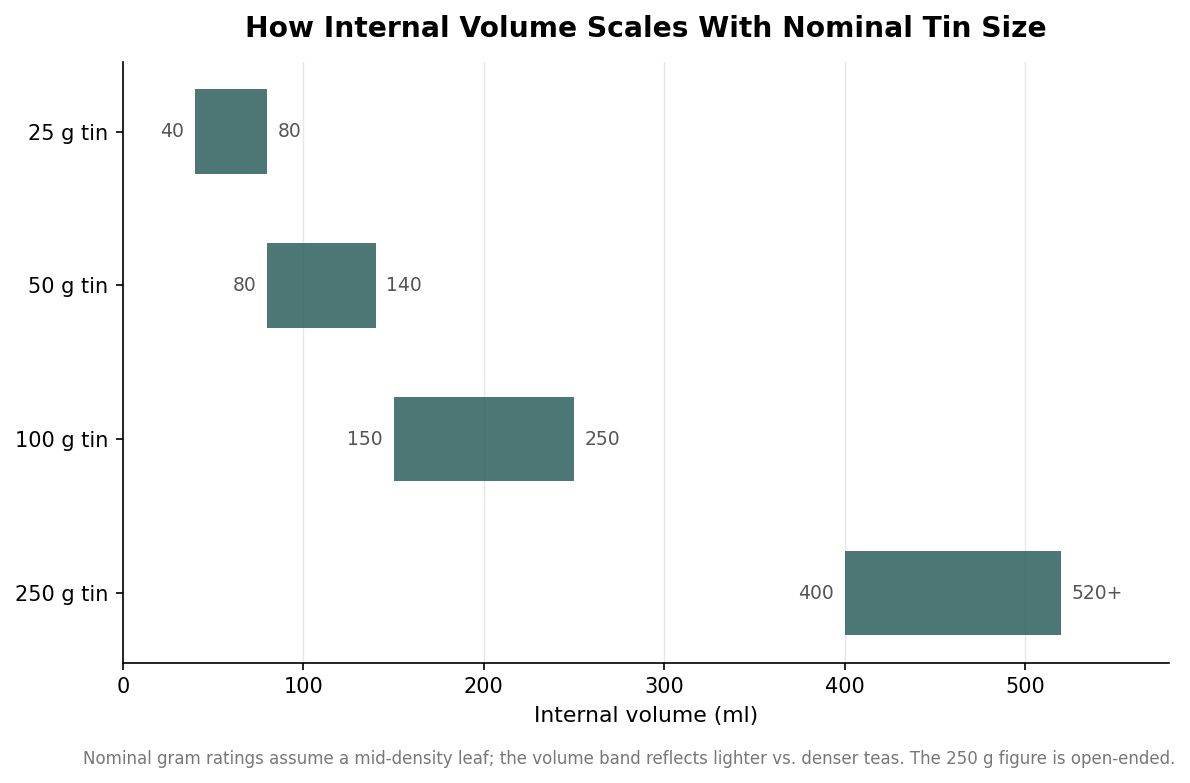
Tins are sold by a gram rating, but tea is bought by volume inside the tin, and the two only line up for a leaf of average density. As a rough guide, a tin rated around 25 grams holds roughly 40 to 80 ml of usable space, a 50-gram tin about 80 to 140 ml, a 100-gram tin around 150 to 250 ml, and a 250-gram tin 400 ml or more. The wide bands are not sloppiness; they exist because bulk density swings hard by tea type.
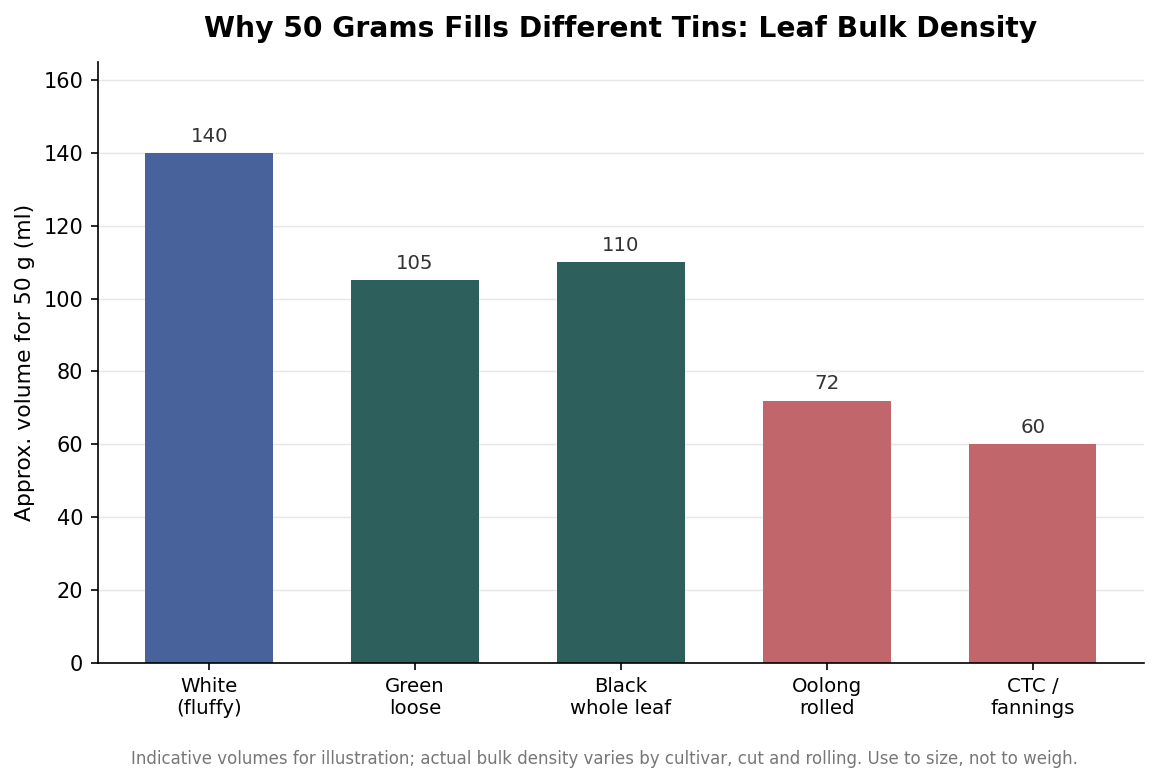
A fluffy white tea can take up close to twice the space of the same weight of tightly rolled oolong, and a fine CTC or fannings-grade black packs down denser still. The practical consequence is that you should size a tin against the specific blend you are packing, ideally by filling a sample tin with your actual leaf, rather than trusting the printed gram figure. If your line spans light and dense teas, expect to use the same tin body at different fill weights, or to offer two sizes.
Lining and material, the part you cannot see
Under the print, most tea tins are tinplate, typically in the range of 0.18 to 0.30 mm, with the heavier gauges going to larger tins that need to hold their shape. What touches the tea is the interior coating, and for a food product it should be a food-safe lining such as a clear food-grade varnish, gold lacquer, or an epoxy-phenolic, polyester, or acrylic coating that meets FDA and equivalent EU food-contact rules. For oily or heavily aromatic blends, low-migration coatings or an inner food-grade bag give an extra margin against the tin and the tea influencing each other’s flavor. This is not a place to economize quietly: the lining is invisible on the shelf but it is the surface your product spends its whole life against, so it belongs in the specification in writing rather than left to the factory’s default. Settle the lining and the seal first, match the outer style to how the customer will use the tea, and the tin will do its one job well.