Most conversations about custom tea tins start with the artwork. The material stack underneath that artwork is what actually keeps the tea drinkable and keeps the package legal to sell, and it is where an inexperienced buyer is most likely to accept the wrong thing. A tea tin is not a single material. It is a thin steel shell, a food-contact lining on the inside, a decorative layer on the outside, and a closure that decides how much air gets in. Understanding each layer makes it far easier to write a spec a factory can actually quote against.
The base metal: tinplate and why the gauge matters
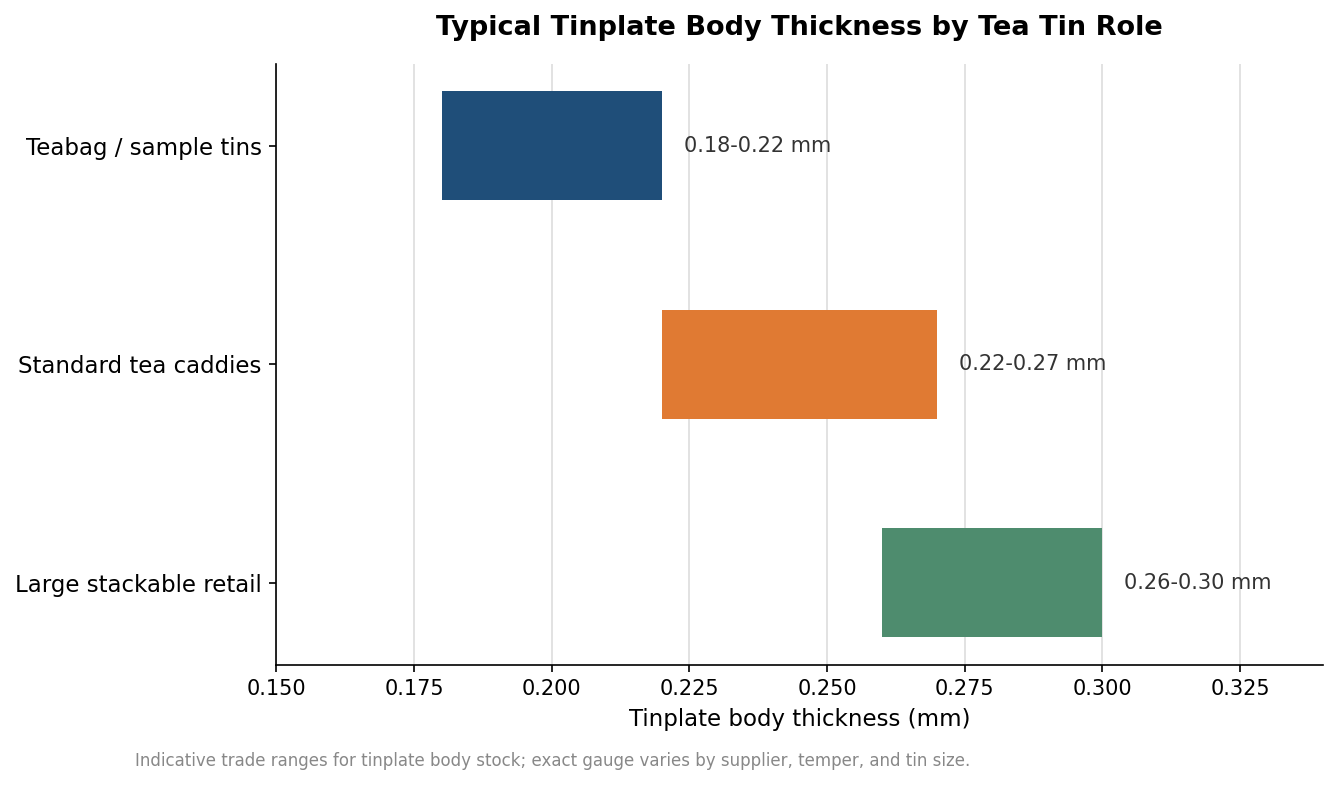
Tinplate is low-carbon steel electrolytically coated with a very thin layer of tin to slow corrosion and give the surface its bright finish. It is not solid tin, and it is not aluminum. The steel gives the tin its structure and dent resistance; the tin coating protects the steel and provides a printable, solderable surface. For tea packaging the body stock is thin, typically in the range of 0.18 to 0.30 mm. Thinner material keeps tooling and shipping costs down but dents more easily, so the gauge tends to track the tin’s job rather than being chosen at random.
Small teabag and sample tins are often drawn from the lighter end, around 0.18 to 0.22 mm, because they are handled gently and shipped in quantity. Standard caddies for loose leaf sit in the middle, roughly 0.22 to 0.27 mm, where the wall is stiff enough to survive retail handling without adding much weight. Large stackable retail tins push toward 0.30 mm so the base and lip stay square under the weight of tins stacked above them. Treat the figures below as indicative trade ranges rather than fixed rules; the exact gauge depends on the supplier, the steel temper, and the tin’s diameter.
The interior lining is what actually touches your tea
This is the layer most buyers overlook, and it is the one that matters most for taste and safety. Bare tinplate can impart a faint metallic note to delicate teas and, in the presence of moisture, can begin to corrode and stain. To prevent that, the inside of a food-grade tin is coated with a food-safe lacquer, usually described as a clear food-grade varnish or a gold lacquer, applied and cured before the tin is formed. Reputable suppliers will specify these coatings as BPA-free and back them with third-party testing such as SGS reports.
The practical point is that the lining, not the steel, is the surface your product sits against. When a supplier quote is vague about the interior, that is the detail to pin down first. If your tea will contact the metal directly rather than sitting inside a sealed pouch, an intact, food-grade interior coating is not optional. For very sensitive products, some brands sidestep the question entirely by placing the tea in an inner foil pouch and letting the tin serve as the outer, decorative, and structural layer.
Food-contact compliance: what to actually ask for
Food-safe is a claim, and claims are worth only as much as the documentation behind them. In the United States, the resinous and polymeric coatings used on the inside of food cans and tins fall under the Food and Drug Administration’s regulations for food-contact coatings, notably 21 CFR 175.300, which governs resinous and polymeric coatings intended for repeated or single food contact. A compliant interior lining is one whose formulation and cure meet that standard. In the European Union, food-contact materials sit under the framework Regulation (EC) No 1935/2004, which requires that materials not transfer their constituents to food in amounts that could endanger health or unacceptably change its taste; Germany’s LFGB is a commonly referenced national benchmark on top of that framework.
When you place an order, ask three concrete things. Ask for the interior coating to be named, not just called food grade. Ask whether the tin has passed migration or overall-migration testing for the market you sell into. And ask for the test report or certificate rather than a verbal assurance. A supplier that regularly ships food packaging will have these documents on hand; hesitation on this point is itself a useful signal.
Where the outside decoration sits, and why it never reaches the tea
The exterior of a printed tea tin is decorated either by offset lithography printed directly onto the steel sheet before forming, or by a wrapped or adhesive label applied to a plain tin. Either way, the decoration lives on the outer wall. Because the interior lining separates the tea from the metal entirely, the exterior inks and coatings do not contact the product. This is why a heavily printed tin can still be perfectly food safe: the two surfaces are on opposite sides of the wall and never meet. It is worth confirming with your supplier that the exterior coating system is also appropriate for food packaging, but the tea itself only ever touches the lining.
Matching the lining and closure to your tea
Material choices interact with the closure, because the closure controls how fast air and moisture reach the tea. A double-lid design, with an inner plug pressed inside an outer slip lid, gives loose leaf a genuine two-stage barrier and is the sensible default for anything sold on freshness. A simple slip lid is cheaper and fine for short shelf lives or teabags in their own wrappers. A hinged lid keeps the closure captive and reads well for teabag tins, though it is not as tight as a plug. Fine powders such as matcha are the most oxygen-sensitive of all and often pair a gasketed, airtight tin with an inner pouch. Gaskets and inner plugs add cost, so it is worth being honest with yourself about how long the tea really needs to stay fresh before defaulting to the most elaborate closure.
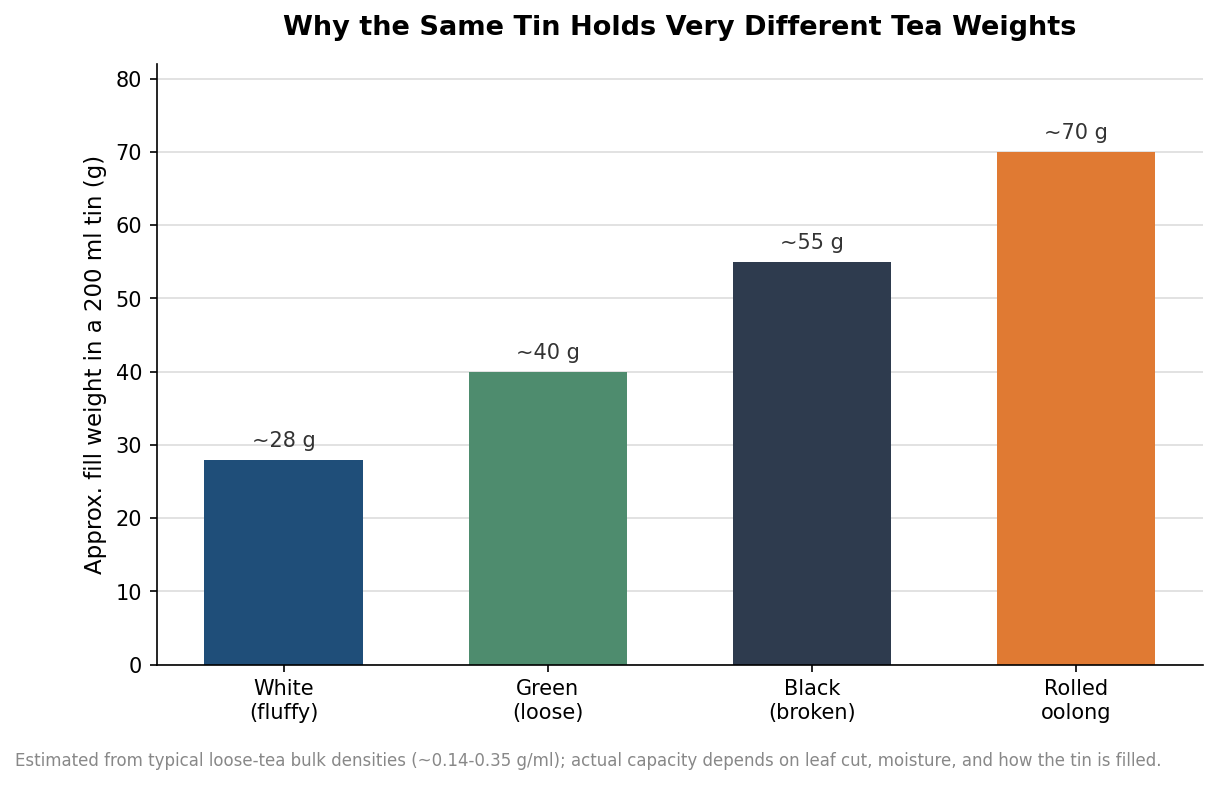
One last practical note that affects both the tin size you choose and the fill weight you print on the label: loose tea varies enormously in bulk density. A fluffy white tea and a densely rolled oolong can differ by a factor of two or more in grams per unit of volume, so the same physical tin will hold very different weights depending on what goes in it. The estimates below show the scale of that effect for a mid-size tin.
Specify a tin by working from the inside out. Tell the supplier the tea type, whether it will touch the metal or sit in a pouch, the target shelf life, and the market you sell into. From those four facts a good factory can recommend a gauge, a named food-safe lining, and a closure that matches the freshness you are promising, and can put the supporting documentation in writing before you commit to tooling.