Most custom tea tin problems are decided before the artwork is ever approved. A tin is a food-contact package, a freshness barrier, and a shelf display all at once, and the mistakes that hurt most are the ones that look fine on a spec sheet and only show up after the tea is inside. Here are the errors that come up again and again on custom tin orders, and the concrete way to avoid each one.
Mistake 1: Sizing the tin by volume instead of by fill weight
The most common and most expensive error is ordering a tin by its milliliter capacity and assuming the tea will fill it. Loose tea is mostly air. Black tea packs at roughly 0.28 to 0.32 grams per milliliter, green tea is lighter at about 0.25 to 0.29, boxed tea bags run 0.35 to 0.40, and only powdered matcha gets dense at 0.45 to 0.50. In practical terms, a gram of loose leaf needs somewhere between 3.1 and 4.0 ml of tin just to sit in, before any headspace.
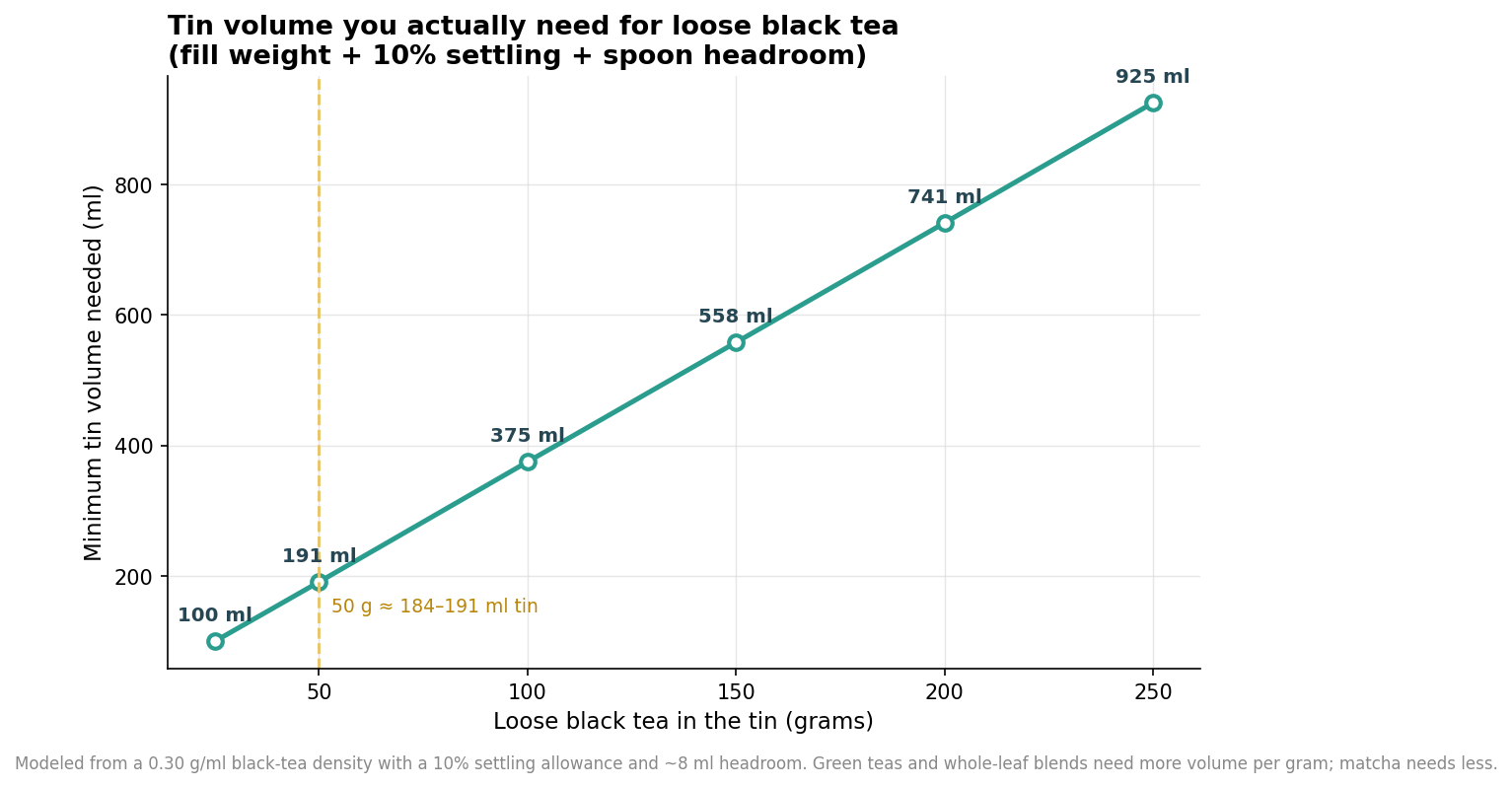
That means a “50 gram” tin is not a 50 ml tin. Fifty grams of black tea occupies about 167 ml, and once you add a 10% settling allowance for compression in transit plus 5 to 10 ml of headroom for a scoop or a resealable pouch, you are looking at a 184 to 191 ml tin. Whole-leaf and fluffy herbal blends sit at the low-density end and need even more room. Always specify the target fill weight and the tea type, and let the tin volume be calculated from there.
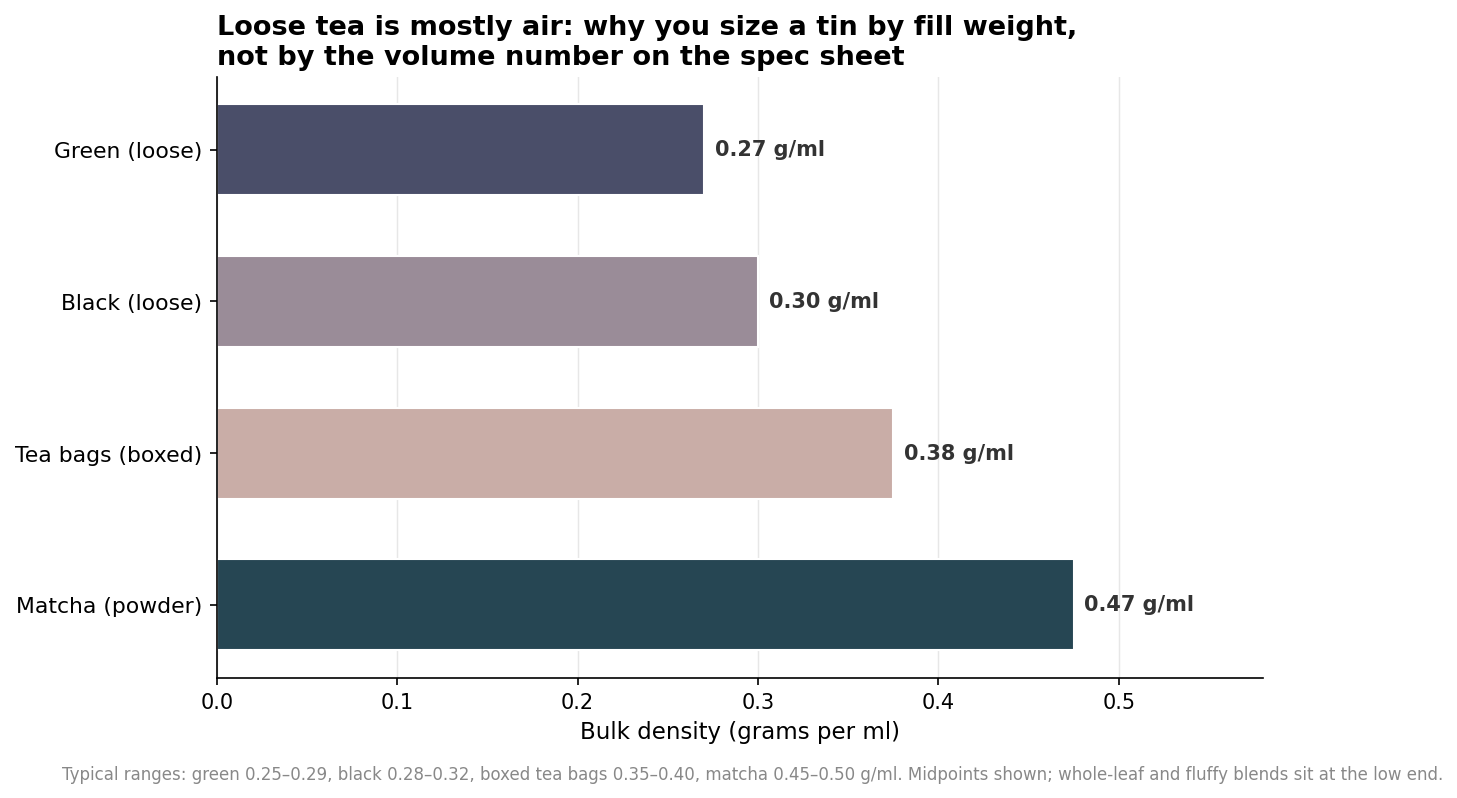
The chart above is why a beautiful tin can arrive looking half empty. Match the volume to the weight and the blend, not to a round number. The relationship is linear once you fix the tea type, so a quick model gets you close before you ever request samples.
Mistake 2: Choosing a window tin for a tea that hates light
Light is one of the fastest ways to age tea, and clear windows trade shelf appeal for shelf life. Ultraviolet and visible light break down the chlorophyll and delicate aromatic compounds in green, white, and yellow teas especially, dulling both color and flavor over weeks on a lit retail shelf. A window is a reasonable choice for a robust, fast-moving black blend that will sell through quickly, or for a gift tin meant to be opened soon. It is the wrong choice for a premium green you want to hold its character for a year. If you love the window look but sell light-sensitive tea, keep the window small and pair it with an inner foil pouch so the seal barrier does not depend on the tin alone.
Mistake 3: Treating every lid as “airtight”
Oxygen and moisture are what make tea go flat, and not all closures hold them out equally. A friction or snap-on lid looks tight and is fine for dry storage over short periods, but it is not a true barrier. A gasketed lid with a food-grade seal, or a double-lid design where an inner lid seals and an outer lid decorates, is what actually slows oxidation and keeps ambient humidity out. The tighter the seal, the longer the tea holds its top notes. Decide the seal type by the tea’s sensitivity and expected time on the shelf, and do not assume the word “airtight” in a listing means a gasket is included. Ask specifically what makes the seal, because a slip lid and a gasketed lid can look nearly identical in a product photo and perform very differently.
Mistake 4: Skipping the interior lining spec
The inside of the tin matters as much as the outside. Tinplate is steel with a thin tin coating, and for direct food contact it should carry a certified food-grade interior lining, commonly a food-safe epoxy or equivalent lacquer, rather than bare metal. There are two reasons this is not optional. The first is safety and compliance: a food-contact package needs a coating rated for that use. The second is flavor. Bare or poorly lined metal can impart a metallic note and, worse, can absorb the aromatic oils of a scented tea, a phenomenon called flavor scalping that leaves an Earl Grey smelling faint and a chai tasting muted. Always confirm the interior coating is food-contact certified, and mention it explicitly if your tea is heavily scented.
Mistake 5: Ordering the wrong way for your run size
Decoration method and order quantity are linked, and getting them out of step wastes money. Full lithographic printing, where the design is baked directly onto the metal, gives the richest finish and the best durability, but it carries plate and tooling setup costs that only amortize across a large run. Litho only pays off once the run is big enough to cover that setup, and below that point a label is the better answer; Custom Tea Tins will tell you where the line falls for your run. For a small launch, a printed label or shrink sleeve on a stock tin is usually the cheaper and faster route, and it lets you test a design before committing to litho tooling. The mistake is forcing a small boutique run through a litho quote, or conversely printing labels for a very large program where litho would have been cheaper per tin and looked better. Decide print method and quantity together, and build in the decoration lead time rather than discovering it after you have committed to a launch date.
None of these are exotic problems. They are the ordinary ways a tin order goes sideways, and each one is avoidable with a single clear line on the spec: fill weight and tea type, light exposure, seal mechanism, interior coating, and print method matched to run size. Nail those five and the artwork is the easy part.