The most common mistake in ordering custom tea tins is choosing the tin by how it looks and only afterward discovering it holds the wrong amount of tea. Half-empty tins look cheap and let leaf rattle and break; overstuffed tins will not close and crush the leaf. Because loose-leaf tea varies so much in density, there is no single answer to how many grams a tin holds, but there is a reliable way to specify one. This is a walkthrough for sizing a tin to your actual product and making sure the inside is safe to hold food.
Start from net fill weight, not tin dimensions
Decide first what net weight of tea each tin needs to hold, because that is what your customer is buying and what your label will state. Then convert to internal volume, which is the number a tin maker actually works from. As an indicative starting point, published tin-capacity guidance maps common retail weights to internal volumes roughly as follows: 25 grams needs about 40 to 80 ml, 50 grams about 80 to 140 ml, 100 grams about 150 to 250 ml, and 250 grams upward of 400 ml. The wide bands are not vagueness; they exist because the same weight of tea occupies very different volumes depending on the leaf. Give your supplier both numbers, the target net weight and a measured internal volume, and confirm the internal volume rather than the outside dimensions, since wall thickness and the lid recess eat into usable space. It is also worth agreeing a small fill tolerance, because tea settles in transit and a tin that looked full on the line can appear to have shrunk by the time it reaches a shelf. Filling by weight rather than by eye, and stating that weight on the order, keeps every tin consistent.
Why the same tin holds different amounts of tea
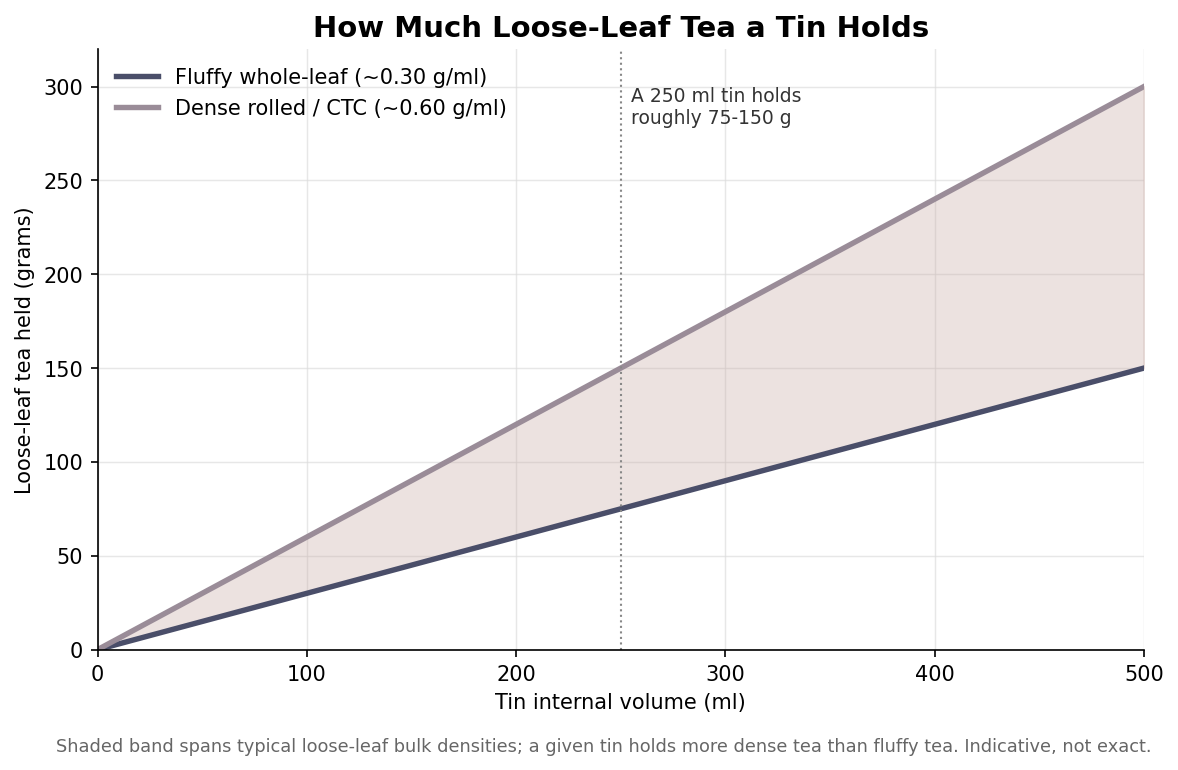
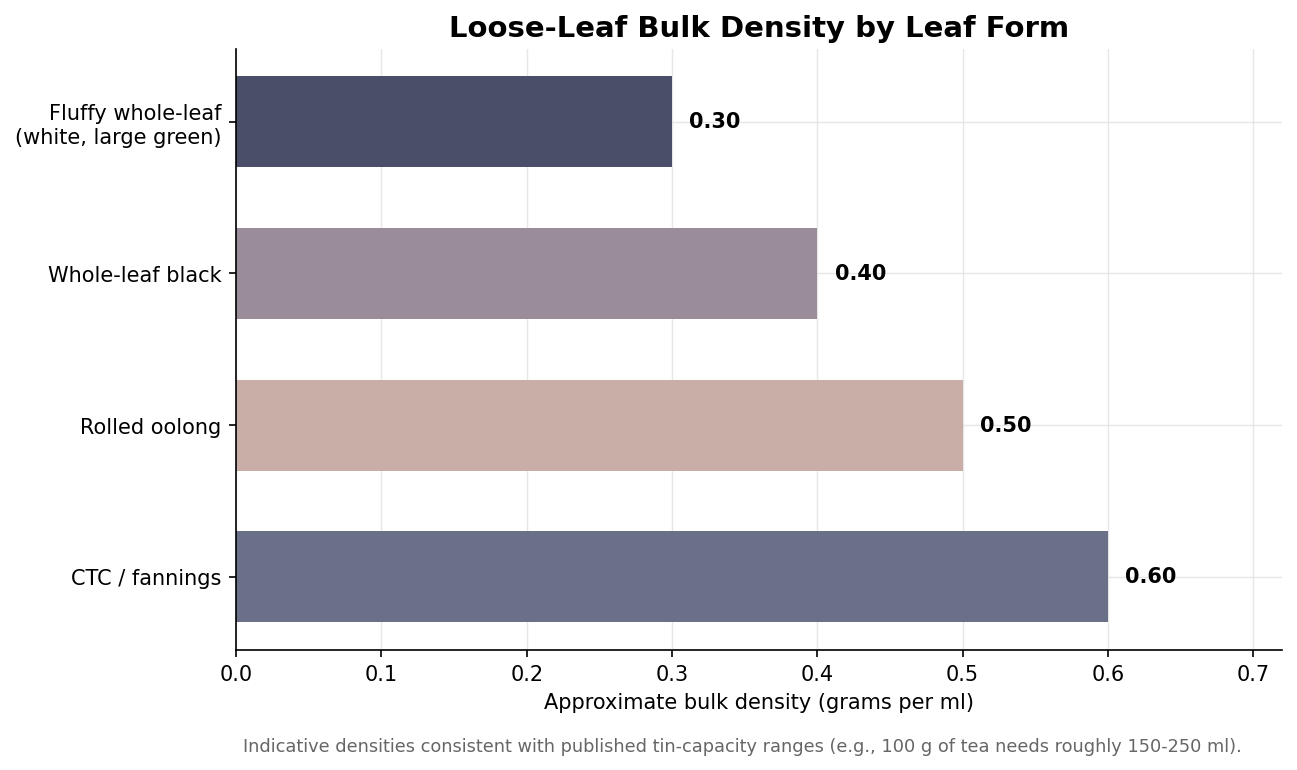
Loose-leaf bulk density typically runs somewhere between about 0.30 and 0.60 grams per milliliter. A large, fluffy white or whole-leaf green tea sits at the light end, so a tin that holds 150 grams of a dense rolled tea might hold only 75 grams of the same volume in fluffy leaf. Rolled oolongs and small-particle CTC or fannings pack toward the dense end. This is why a teaspoon of one tea weighs two grams and a teaspoon of another weighs three. If you sell several blends in the same tin for a consistent shelf look, size the tin to the fluffiest blend so every product fills the tin, then accept that your dense blends will leave a little more headroom rather than the reverse.
Leave headspace and match the closure to the seal you need
Do not spec a tin filled to the brim. A practical fill leaves roughly 15 to 20 percent headspace so the lid seats without crushing leaf and so there is room to scoop. The closure then depends on how airtight the tin must be on its own. A friction-fit lid is fine for retail tins where the tea also sits inside an inner pouch. A screw lid with a food-grade silicone or elastomeric gasket gives a reusable, more robust seal suited to a caddy the customer keeps refilling. Magnetic and loose slip lids look elegant but are not airtight, so pair them with an inner foil or resealable barrier bag if the tin is the primary package. Tea loses aroma to oxygen, light, and moisture, so the closure decision is really a freshness decision as much as a convenience one.
Specify a food-safe interior, not just a pretty exterior
A tin that touches tea directly needs a food-contact-safe interior. Most food tins are tinplate, which is thin steel with a tin coating, finished inside with a food-grade lacquer. For a dry, low-acid product like tea, common interior coatings include epoxy-phenolic lacquers (now available in BPA-non-intent formulations), polyester varnishes, and acrylic or vinyl coatings that suppliers specifically list as suitable for dry foods and tea. On the regulatory side, suppliers commonly reference FDA 21 CFR 175.300 for resinous and polymeric coatings in the United States and framework regulation (EC) No. 1935/2004 in the EU and UK. The practical step for a buyer is simple: ask the supplier in writing to confirm the interior is food-contact-safe for tea and to provide a Declaration of Conformity or equivalent test documentation before the run ships. If you would rather not rely on the coating alone, an inner food-grade liner or foil pouch keeps the tea off the metal entirely, which also helps with freshness. Keep in mind that the exterior decoration is a separate question from the interior: a lithographed or printed outer surface has no bearing on food safety as long as the inside carries its own approved coating, so do not let an attractive outside distract you from confirming what lines the tin.
Putting the spec together
A complete tea-tin spec names the net fill weight, the confirmed internal volume with headspace built in, the leaf form you are packing so the maker can sanity-check the density, the closure type and gasket if any, and a written confirmation that the interior is food-contact-safe with supporting documentation. Sized this way, the tin arrives full and closing properly, the tea inside stays fresh as long as the closure allows, and you are not left explaining to a customer why a tin sold as holding 100 grams looks two-thirds empty. Spend the extra few minutes translating weight into volume up front and you avoid the most expensive kind of packaging error, the one you only find after the whole order is printed and delivered.